


Repository Management
Automatic creation and management of standardized student workspaces with source code repositories, wikis, CI/CD pipelines, and collaboration tools.
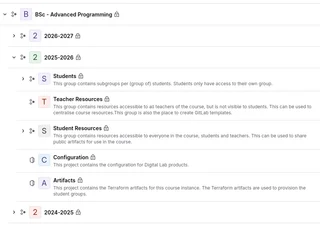
With our Repository Management service, creating collaborative codespaces for students becomes trivial. In a matter of minutes a GitLab-based workspace for each student or group of students is created, even if your course has hundreds of students. The student workspace consists of source code repositories, wikis, issue boards, continuous integration and development pipelines, and other tools that closely mirror a professional software development environment. In addition, there are places where you can share resources (code, documents, assignments) with all students simultaneously, as well as places where you can share resources with your education team (co-lectures, teacher assistants).
Benefits for staff
Through the standardization of these workspaces, the Digital Lab ensures that course coordinators do not need to spend time setting up and configuring repositories and projects themselves. Students receive a uniform workspace that is consistent between courses, reducing the time it takes to gain familiarity with the environment, and increasing the time you can spend on things that really matter in your course.
Benefits for students
- A realistic, industry-standard working environment from day one.
- Consistent workspace structure across courses, reducing onboarding time each semester.
- Source code repositories promote formative feedback through merge requests that can be reviewed by teachers and teaching assistants.
Use cases
Advanced Programming
Advanced Programming is large-scale course in which over a hundred students learn the foundations of software design. Unlike most other courses, students do not start with a fresh project, instead, they are asked to work on a brownfield project that is used as a template to populate their workspace.
- Languages — Java, Kotlin
- Assignment types — Brownfield software engineering
AI Engineering Practical
In this courses students learn about the practical side of deploying machine learnings model in real-world environments. Each group of students works on a completely different project with each having a different technology stack. Despite these differences, each student has the same workspace to complete their project in.
- Languages — Student's choice
- Assignment types — Each group has a different project
Introduction to Data Science
This course teaches the fundamental principles of data science to a multi-disciplinary cohort of students. These students have varied backgrounds, from Computing Science and Artificial Intelligence to Applied Mathematics and Astronomy. The course uses a shared repository to which both students and staff have access, in this shared repository students can ask questions which are then answered by the teaching staff.
- Languages — Python, MatLab
- Assignment types — Programming assignments
Notable Features
Templating
Automatically provision student workspaces with predefined templates.Reviewing
Let teaching staff or even other students review the code written by someone else.Scalability
When your course grows from 10 to 100 students, Repository Management is able to scale with your course.Industry Standards
Students learn to work with industry-standard workflows, such as CI/CD pipelines, issue tracking, and code reviews.
Interested?
Are you interested in using Repository Management? Contact the Digital Lab at digitallab@rug.nl.